Dimensioning the stairs - how many steps are needed for the stairs?
Stair dimensions and height difference H from the floor of the ground floor to the floor level of the upper floor. Select the initial step height h: easy access 150 mm, standard 180 mm, steep 200 mm. Then calculate how many rises you need: divide the difference in height by the rise you have chosen.
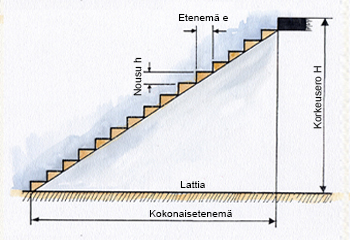
The sizing of the stairs is calculated as follows
For example, if the difference in height is 2 800 mm and you choose a rise of 180 mm, the result is 15.55 steps, rounded up to an even number of 16 steps. If you now divide 2 800 mm by 16, the actual rise is 175 mm.
Now it's time to calculate the progression e. So if the rise is 175 mm, you get the distance by calculating 630 - 2 x 175 mm = 280 mm. 630 mm is a standard number determined by the normal cadence. Its value can vary, for example, between 590 and 650 mm.
Staircase dimensioning: steps and treads
The total length is the length of space occupied by the stairs from the edge of the lowest stair to the back edge of the top stair. The number of steps is one less than the number of rises, in our example 15. The last rise is not counted, as it is an upstairs floor and not a step.
Calculated in this way, you will notice that the stairs take up quite a lot of space. 15 x 280 mm is 4 200 mm, or 4.2 metres, and the space needed for the lowest step is at least 800 mm, which brings it to 5 metres. If the space is not enough, increasing the rise to, say, 190 mm might help.
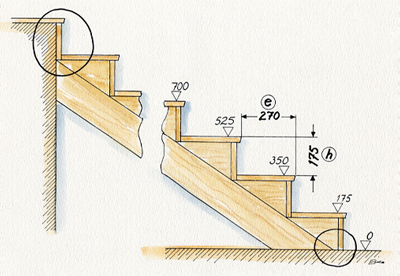
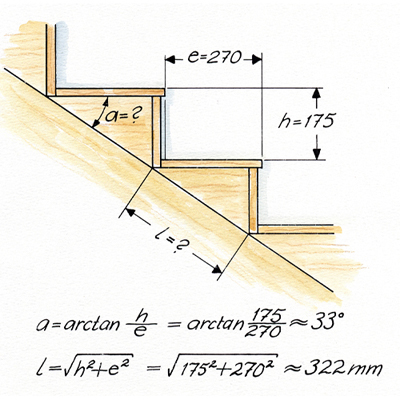
The traditional way to make a staircase is to use triangular blocks attached to the thigh planks, as shown here. To proceed e, do not count the part that goes over the step or the chamfer. When the calculations have been completed accurately, it is a good idea to draw the outline of the steps on the wall next to the stairs, and once again check that the top and bottom steps come to the same height as the others.
Which wood should you use for the stairs?
For indoor stairs, well-dried and high-quality timber is usually used. If the moisture content of the wood is too high, it may warp and crack as it dries at room temperature.
For external stairs, it is recommended to use timber that has not been planed. Unplaned wood reduces the slipperiness of surfaces.
- Tiling works
- Paint and plaster
- Elemental work
- Facade work
- Roofing
- Installation letsnits
- Installation of handrails
- Laying bricks and blocks
- Installation of kitchen
- Mounting tension ceilings